
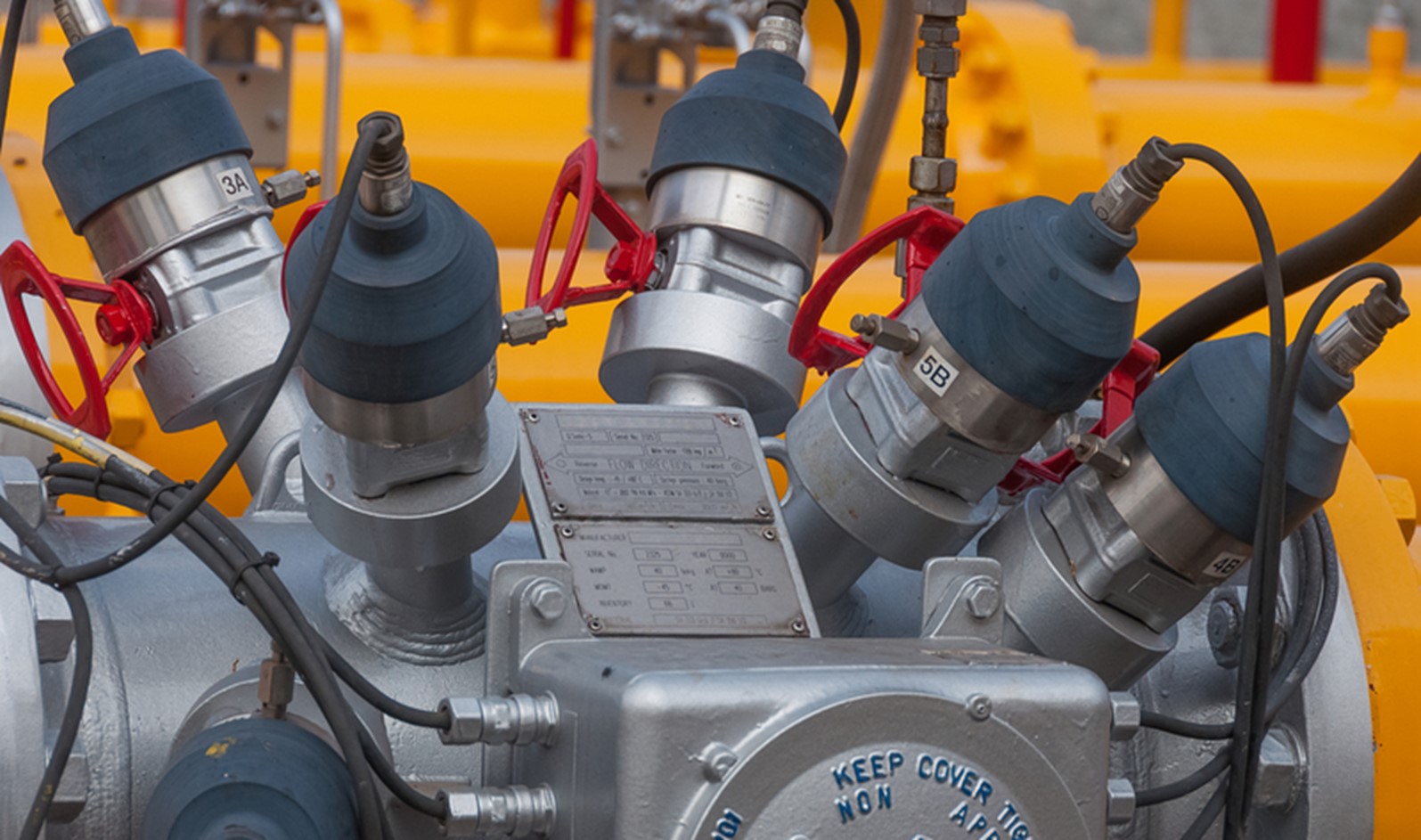
Ultrasonic flowmeters feature high accuracy, high reliability, high turndown ratios, long service life, low maintenance, relatively low cost, valuable diagnostics, no moving parts, and redundancy capabilities. They are used in a variety of applications, including oil & gas.
Transit time and Doppler ultrasonic meters
There are two main types of ultrasonic flowmeters: transit time and Doppler.
A transit time ultrasonic flowmeter has both a sender and a receiver. It sends two ultrasonic signals across a pipe at an angle: one with the flow, and one against the flow. The meter then measures the “transit time” of each signal. When the ultrasonic signal travels with the flow, it travels faster than when it travels against the flow. The difference between the two transit times is proportional to flowrate.
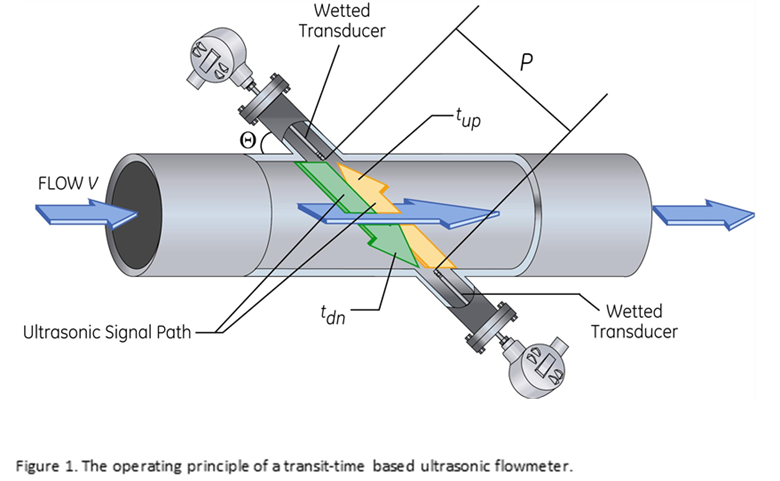
Transit time ultrasonic flowmeters are distinguished according to the number of “paths” they have. A path is simply the path or track of the ultrasonic pulse as it travels across the pipe and back again. Many ultrasonic flowmeters are single or dual path, meaning that they send either one or two signals across a pipe and back. Typically, there are two transducers for each path; one is a sender and one is a receiver.
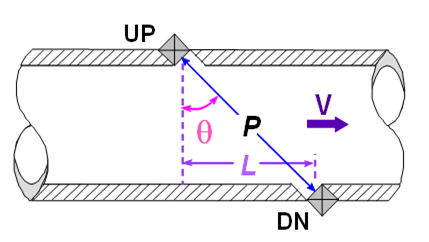
The following parameters pertain to the diagram above:
• The path length P
• Sound speed c
• Flow velocity V
• Beam angle q
Doppler flowmeters also send an ultrasonic signal across a pipe. Instead of tracking the time the signal takes to cross to the other side, a Doppler flowmeter relies on having the signal deflected by particles in the flowstream. These particles are traveling at the same speed as the flow. As the signal passes through the stream, its frequency shifts in proportion to the mean velocity of the fluid. A receiver detects the reflected signal and measures its frequency. The meter calculates flow by comparing the generated and detected frequencies. Doppler ultrasonic flowmeters are used with dirty liquids or slurries. They are not used to measure gas flow.History
Early history

Tokyo Keiki first introduced ultrasonic clamp-on flowmeters to commercial markets in Japan in 1963. In 1971, Badger Meter first brought clamp-on ultrasonic flowmeters to the United States by reselling Tokyo Keiki’s meters. In 1972, Controlotron began manufacturing its clamp-on ultrasonic flowmeters in Long Island, New York. In the late 1970s and early 1980s, Doppler flowmeters began to be used. Because they were not well understood, they were often misapplied. As a result, many users got a bad impression of ultrasonic flowmeters during this time. In the 1990s, transit-time emerged as the leading ultrasonic technology, and ultrasonic meters began growing significantly in popularity and capabilities.
In the early 1980s, both Panametrics and Ultraflux experimented with ultrasonic meters for gas-flow measurement. In the mid-1990s, a group called Group Europeen de Recherches Gaziers (GERG) published a technical monograph on ultrasonic flowmeters for gas flow measurement. A monograph out of GERG led to increased European ultrasonic flowmeter use from 1996 to 1999.
The GERG monograph laid the groundwork for the publication of AGA-9 by the American Gas Association. AGA-9 lays out criteria for using ultrasonic flowmeters for custody-transfer applications. Since its publication in June 1998, ultrasonic flowmeters have become widely used for custody transfer of natural gas. They are especially suited for measuring gas flow in large pipelines, easily handling flow in those above 20 inches in diameter, as well as smaller pipelines. Its main competitors for custody transfer of natural gas are the differential-pressure (DP) orifice meter and turbine flowmeter.
It used to be standard practice to divide the ultrasonic flowmeter market up according to whether the meters are transit-time, Doppler or hybrid. Traditional use of transit-time meters was to clean liquids, while Doppler meters handle fluids with impurities. Hybrid meters are a combination of transit-time and Doppler, and use one technology or the other, depending on the fluid. In the past 10 years, transit-time suppliers made great progress getting transit-time meters to measure fluid flows with some impurities. As a result, Doppler and hybrid meters are less important since transit-time meters are now used for applications previously reserved for Doppler meters. Another reason for growth in transit-time meters is their use in energy industries, mainly oil and gas, within which Doppler flowmeters play no major role.
Mounting type is now the more useful way to classify ultrasonic flowmeters, rather than transit time vs. Doppler. Three main mounting types for ultrasonic flowmeters include:
- Inline
- Clamp-on
- Insertion
Inline ultrasonic flowmeters are mounted with a meter body in the pipe. Inline meters achieve the highest accuracy of any ultrasonic meters, and multipath ultrasonic meters are inline meters. Multipath meters have three or more ultrasonic signals or “paths” to determine flow velocity. This gives them greater accuracy than single- and dual-path meters. The most common number of paths is four, five and six, but some multi-path meters have eight, 12 or even 18 paths. Inline meters are used for custody transfer applications.
Clamp-on meter disadvantages limit their usefulness in certain situations. The ultrasonic signal can be attenuated by the pipe wall. Knowing pipe-wall thickness and composition can be important. In addition, build-up on the inside of the pipe wall can affect the internal diameter of the pipe. Knowing the internal pipe diameter is important to getting a correct flowmeter reading. Over time, however, as clamp-on technology has matured, many of these issues have been either greatly reduced or eliminated. As a result, end-users have come to understand and appreciate the basic advantages of clamp-on flowmeters. These advantages include high reliability, high turndown ratios, long service life, low maintenance, relatively low cost, valuable diagnostics, no moving parts, bi-directional flow measurement, and redundancy capabilities. Clamp-on meters are easily installed, and do not interrupt the flow or cause pressure drop. They are small, lightweight, and easy to use, and come in a wide range of pipe materials and sizes.
Insertion meters are sometimes used in large pipes when a spool-piece would be expensive. They have a cost-advantage over inline meters since there is no meter body. Insertion meters go into a hole drilled in the pipe wall. They are widely used in stack-gas and exhaust-flow monitoring. Here they compete with DP flowmeters using averaging Pitot tubes and with thermal flowmeters.
History since 2001
The history of ultrasonic flowmeters since 2001 can be viewed from multiple perspectives. One way is to look at the product development that has occurred during this time. There have been many advances in custody transfer meters, in developing multipath meters, in gas flow measurement, in developing diagnostic capabilities, and in calibrating ultrasonic meters. Some of these changes are discussed in Chapter Four of this study, and also in Chapter Five in the growth factors section.
Another way to view the history of this period is by looking at the history of mergers and acquisitions that have occurred in the past 20+ years. Here are some of the more notable changes:
- In 1998, Emerson bought Daniel Industries, a manufacturer of ultrasonic and turbine flowmeters.
- In 2001, Badger Meter’s ultrasonic division was acquired by Eastech Flow Controls
- In 2002, Accusonic was acquired by ADS Environmental. Accusonic sells open channel flowmeters for large pipe applications; water, wastewater, and power generation markets; multi-path transit-time.
- In 2003, Siemens acquired the flow division of Danfoss. This division is a manufacturer of magnetic, ultrasonic, and Coriolis flowmeters.
- In 2005, Siemens bought Controlotron, a manufacturer of clamp-on ultrasonic meters.
- In 2012, Badger Meter acquired Racine Federated, including Dynasonics, a manufacturer of ultrasonic flowmeters.
- In 2015, Honeywell International bought Melrose Industries’ Elster unit, which included ultrasonic and turbine flowmeters.
- In 2016, Schlumberger acquired Cameron International, a supplier of high-end ultrasonic flowmeters for the nuclear industry.
- In 2017, Baker Hughes merged with GE Oil and Gas in 2017 to become Baker Hughes, a GE Company (BHGE), then divested from GE in 2019 and became Baker Hughes Company. GE still holds 57.5% of shares. GE acquired Panametrics in 2002.
- In 2017, Technip merged with FMC Technologies to form TechnipFMC.
- In 2019, Schlumberger and Rockwell formed a joint venture called Sensia.
- In 2021, Emerson sold Daniel Industries, a manufacturer of ultrasonic and turbine meters, to Turnspire Capital Partners. However, Emerson kept its ultrasonic meters and labeled them Emerson Rosemount, having sold off the Daniel name to Turnspire.
- In 2023, Emerson acquired Flexim, a manufacturer of ultrasonic clamp-on meters based in Germany.
- In January 2026, Baker Hughes completed the sale of its Precision, Sensors, & Instrumentation division, including Panametrics, to Crane Company for $1.15 billion.
Frontiers of research

Suppliers are devoting development and marketing to significant ultrasonic meter enhancements. Here are some of the frontiers of research:
Innovative enhancements reduce profile uncertainty, enhance self-diagnosis, mitigate false alarms, and increase accuracy
Inline ultrasonic flowmeter suppliers are tackling these related frontiers of research in a variety of creative ways:
Sensia’s new self-verifying (SVM) ultrasonic flowmeter claims to be the first gas or liquid custody transfer meter to deliver a quantitative and continuous evaluation of its own performance, calculating its own live measurement uncertainty. The company’s 16-path CALDON SVM 289Ci incorporates new patented technology to estimate simultaneously calculate measurement uncertainty alongside each flow measurement calculation, updated once per second. It builds on the company’s eight-path Caldon 380Ci 280 (liquid) and 380 (gas) models. The SVM uses Sensia’s proven 8-path configuration for its primary measurements and a fifth chordal measurement plane to compare 4-chord (8-path) versus 5-chord (10-paths) results of flow profile uncertainty. The SVM technology also provides axial velocity measurement verification for the chords and a vertical reflective path to detect entrained gas or contamination. The meter removes time-based recalibrations by dynamically alerting operators to any issues in and providing a quantitative evaluation of the meter’s performance. They are also totalized, and can be logged and examined for future reference. Like Sensia’s 8-path meter, the SVM does not require a flow conditioner to address the effects of non-axial flow/swirl. The company claims that error detection is more reliable than two meters in one body, which can be subject to false alarms. The meters can detect and quantify the influence of complex changes such as variations in path geometry and signal detection issues.
Honeywell’s gas Q.Sonicmax meter, launched in June 2017, claims to be the first eight-path ultrasonic meter to combine both reflective and direct paths. The patented path configuration offers detailed flow profile recognition with noise immunity to provide the lowest uncertainty possible with the most extensive diagnostics capabilities. The reflective paths and diagnostics mean the meter quickly identifies swirl, fouling, or liquids inside the meter. The direct paths provide enhanced robustness for higher valve noise immunity and accuracy in CO2-rich applications. The configuration enables Q.Sonicmax to detect and correct for disturbances in the gas flow caused by short inlets, extenders, reducers, manifolds, elbows, and other piping elements common in natural gas plants.
GWF’s SONICO® EDGE ultrasonic flowmeter for drinking and utility water applications uses a time-reverse acoustic principle to provide measuring repeatability unaffected by flow perturbations, water conductivity, or electromagnetic or grounding interference. The meter’s 4D-shape measuring core means it can be installed directly before or after 90o elbows, valves, and pumps without straight runs, and without the need for flow conditioners.
Baker Hughes’ Panametrics Sentinel LCT8 for custody transfer of hydrocarbon liquids uses some the meter’s eight paths to cancel the effects of swirl and other disturbances.
KROHNE’s ALTOSONIC inline flowmeters for custody transfer measurement of gas and oil use speed of sound measurement as a continuous verification tool for custody transfer of natural gas. The ALTOSONIC V12’s 12-path configuration eliminates the need for a flow conditioner and makes it immune from swirl. No knowledge of the gas composition is needed. The meter includes extensive condition-based monitoring (CBM) diagnostics. Dedicated diagnostic paths detect deposits, dirt, and other changes in surface roughness. To help ensure gas process continuity if a transducer fails to operate within custody transfer parameter limits, the ALTOSONIC V12 uses dynamic chord substitution that use previously stored velocity ratios between the different chords to calculate the exact velocity at the position of the failed path.
SICK’s FLOWSIC600-XT 2plex combines a very compact gas flowmeter and control measurement device with an independent measurement path that extends diagnostic functionality. SICK’s FLOWSIC600-XT Forte uses eight paths on two different path levels to deliver high accuracy. The FLOWSIC600-XT Quatro unites two measurement devices for redundant custody transfer measurements into one, with an installation length equivalent to that of a single device.
Faure Herman’s FH Sonic for custody transfer of liquids and other demanding applications integrates up to five parallel measuring paths arranged asymmetrically to optimize flow profile evaluation for measurement correction, plus an embedded sixth path dedicated to diagnostics. This configuration can be “doubled” by adding a second set of five paths, symmetrically arranged in the horizontal plane, to reinforce the analysis and correction capacity of the flow profile or to have an independent check meter in the same unit.
Emerson’s Rosemount 3418 eight-path gas ultrasonic flowmeter uses eight transducer/receiver pairs, each placed to read velocity at four positions, with the first set of four set in the mirror image of the second within the body, with flow in either direction. Each position provides two chords across the pipe diameter, so there are eight measurements taken over 32 milliseconds. This approach creates an accurate picture of gas movement and volume for greater measuring precision.
Fluenta combines two signal types – a variable “chirp” signal and a continuous sine wave signal – to enhance the accuracy and stability of its inline and insertion FGM-160 meters, preventing the loss of signal while measuring the extremes of high and low velocities. Fluenta claims accuracy as high as ±1% and a turndown ratio of 4000:1. The FGM 160 Dual-Path adds higher accuracy (±0.75%) and redundancy with two pairs of transducers mounted opposite each other in several different configurations. If one transducer fails, the other pair of transducers continues to operate at the same accuracy level as a single path FGM 160.
The TUS inline high pressure ultrasonic transit-time gas flowmeter, jointly developed by Goldcard and Tancy, includes built-in WiFi and supports 4G/5G communication. A self-diagnosis function analyzes the device’s status and retrieves historical lifecycle data about the device from the cloud. A built-in high-precision temperature sensor automatically corrects the expansion coefficient of the shell.
TechnipFMC’s new Smith Meter® Ultra 8c meter for heavy liquids uses eight transducer paths to measure swirl and cancel any resulting transverse velocities. The eight paths and dynamic profile compensation offer ±0.12% linearity over 15:1 normal flow range and repeatability of ±0.02%. Swirl cancellation permits installations with 5D upstream straight runs without flow conditioning. The company’s MPU 1600c custody transfer gas flow measurement, provides minimal pressure drop with only a required 5D upstream straight run in even harsh outdoor petroleum applications. The meter cancels swirl velocities without flow conditioning and offers next generation electronics for improved gas measurement accuracy (nominal accuracy of ±0.1% and repeatability of ±0.05% or better with flow calibration), diagnostic intelligence, and installation flexibility. On-board memory for diagnostic analysis stores continuous, configurable process data that can provide an analysis of process conditions and meter operations by downloading the file – without logging. A web-based interface improves access. Advanced digital signal filtering and processing enhances noise immunity.
Wet gas in upstream measurement
The complex upstream market is a frontier of interest for many ultrasonic flowmeter manufacturers, which see untapped opportunities for measurement as well as possibilities for making inroads in existing differential pressure and turbine usage. Issues in the upstream market include unplanned downtime, greenhouse gas (GHG) emissions monitoring, and opportunities for greater predictive focus on safety and security. But one of the main frontiers – and biggest pain point – for ultrasonic meters in this market is the presence of liquids and other elements at gas measuring points.
Raw natural gas at gas production wells and pipelines or associated gas at oil fields can contain natural gas liquids (NGLs) – hydrocarbons like ethane, propane, butane, isobutane, and pentane; water, oil, or glycol, as well as dirt, dust, and mechanical particles and even wax or paraffin. Shale play areas in particular often have very high BTU gas that consequently may contain NGLs. Some gas producers have determined it is easier to allow the NGLs to flow with the gas until they are separated at a compressor station, measured (often with a Coriolis meter), and then re-injected into the downstream pipeline after compression. This process continues until the gas and the liquids arrive at a cryogenic plant that removes the NGLs and delivers pipeline quality gas.
According to RMG, some gas producing clients are convinced inline ultrasonic gas meters will fail quickly when liquids are present and believe the orifice meter is the best solution for wet gas applications. But tests at CEESI with RMG’s 4-inch and 8-inch GT400-3P inline ultrasonic meters – without a flow conditioner – against a 4-inch orifice plate have shown that inline ultrasonic meters can significantly outperform orifice plates in wet gas conditions. RMG’s six-path USM GT400 gas flowmeter directly measures bulk flowrate, swirls, crossflow, and asymmetry. The meter’s six paths arranged in three parallel planes provide high stability against turbulence. It also features fully encapsulated, robust, dirt-repellent titanium sensors. A patented precision adjustment/echo measurement feature reduces meter uncertainty to as low as ±0.1%. Additional qualitative analysis evaluates the pulse envelope and identifies ultrasonic pulses without slowing the pulse rate. The six-path meters maintain their custody transfer metering capabilities even if any one or two of their acoustic paths fail. The failed paths are reconstructed by a replacement-value function learned by the gas meter using the measuring results of all functioning paths.
SICK, which started investigating the upstream market in 2006, now offers the inline FLOWSIC600 DRU series for upstream gas applications that features a protruded transducer position and large transducer bore and as well as remote, real-time monitoring of measurement and diagnostic data. The extracted raw gas can contain water, natural gas condensates, and potentially highly corrosive and toxic components. The robust wet gas sensor provides continuous measurement even with permanently higher liquid loading. CEESI testing found that the SICK meter also provides a significantly more predictable result than an orifice meter, especially under high liquid loading, with a smaller footprint and less carbon release due to isolating meter runs and de-pressuring to inspect and change orifice plates.
Hydrogen, Renewable Natural Gas, and Energy Transition
Some ultrasonic flowmeter manufacturers now offer meters that measure hydrogen in and are continuing to explore how to best measure hydrogen and hydrogen blends. They are also eyeing whether to enter the renewable energy market, which includes hydrogen renewable natural gas from methane and synthetic fuels.
Hydrogen’s physical properties are quite different from other gases, including natural gas, and flowmeter suppliers have had to adapt to those differences, as well as figure out ways for ultrasonic meters to accurately measure hydrogen blends.
Hydrogen from biogas and other renewable energy is seen as one of the pillars in the current transition to integrating renewables into the broader energy system. The American Gas Association calls green energy’s role “pivotal” in the current energy transition. The AGA believes that the Clean Hydrogen Production Tax Credit and other provisions in the Inflation Reduction Act guarantee that clean hydrogen will be critical going forward and that an important challenge is making hydrogen use scalable, with sufficient production and distribution capabilities.
Most hydrogen today is extracted from fossil fuel natural gas (sometimes called “grey hydrogen”). It is widely used today in industrial processes, including, for example, in manufacturing high-grade steel and as a reactive agent to refine petroleum products by breaking down heavy molecules and removing impurities. In a production process for fatty alcohols, hydrogen is used as a circulating gas. Within the process, hydrogen is used both as a raw material and the primary carrier medium. Hydrogen can also be used to power vehicles, generate electricity, power industry, and heat homes and businesses – although some research indicates that heating with hydrogen is a lot less efficient and more expensive than alternatives such as heat pumps, district heating, and solar thermal.
Now two types of carbon-neutral hydrogen, plus a mixed type, are on the rise:
- Blue hydrogen, extracted from natural gas, captures the CO2 generated during the process and stores it permanently underground for a carbon-neutral footprint.
- Green hydrogen (H2) is produced by splitting water into hydrogen and oxygen in an electrolyzer powered by renewable energy. It is a versatile energy carrier that can be used directly instead of grey hydrogen or combined with other elements to create synthetic electrofuels (e-fuels) like e-ammonia and e-methanol.
- Mixed hydrogen combines blue or green hydrogen in natural gas pipelines to reduce carbon emissions.
Green hydrogen is a versatile energy carrier that can decarbonize a wide range of sectors. It can be used directly or in the form of its derivatives like e-methanol, e-ammonia, or e-fuels to replace fossil fuels, coal or gas. One of the most important aspects of green hydrogen is that it can store and transport solar and wind energy for use where and when it is needed. Green hydrogen can be stored for long time periods, in large quantities, and without loss, and then transported and used directly or converted back into electricity and heat. According to the AGA, hydrogen has “immense potential” for energy storage because the capacity of America’s gas pipelines and gas storage facilities exceed all battery capacity provided by every lithium battery on earth. (Lithium-ion batteries are currently the dominant storage technology for ensuring a reliable supply to electricity grids.) Using hydrogen would allow us to transition to a higher mixture of renewable energy without diminishing the reliability of our energy distribution infrastructure.
KROHNE’s 12-chord ALTOSONIC V12 inline ultrasonic custody transfer (CT) flowmeter measures pure hydrogen, natural gas, and blends of hydrogen with natural gas.
Emerson’s four-path Rosemount™ SeniorSonic 3414 gas ultrasonic meter allows customers to blend hydrogen into their current pipeline at levels of up to 30% and still maintain high accuracy and reliability.
Endress+Hauser’s inline Proline Prosonic Flow B 200 ultrasonic meter deploys loop-powered technology to measure wet biogas and digester gas. An integrated real-time methane fraction analysis provide continuous measuring and monitoring of both gas quality and gas flow.
KROHNE’s dual-beam OPTISONIC 7300 Series accommodates industrial process and pipeline gas, compressed gas, fuel and biogas, and low pressure steam. Titanium sensors with improved signal processing can measure process gases with different and changing compositions, including noise, and avoid measurement errors.
As for blended gases, nine ultrasonic flowmeter manufacturers – RMG, Honeywell, Krohne, FLEXIM, Pietro Fiorentini, Endress+Hauser, Emerson, SICK and Tancy – participated in a joint industry project (JIP) formed in 2020 to understand the performance of flowmeters when hydrogen and CO2 are mixed with natural gas. Two of the nine meters, including RMG’s inline meter, showed no systematic drift behavior although the other seven meters showed drift considered significant as compared to the meter’s transferability, which was defined as the reproducibility from one gas to another gas.