Category: Vortex

  • Large pipe flow measurement: large sensors or small meters?

    Flow measurement in large pipes has long presented a challenge for many types of flowmeters. Coriolis meters become heavier, more unwieldy, and more expensive as the line sizes they are measuring increase. Vortex meters face similar issues. As line sizes increase, bluff bodies grow larger and vortex shedding frequencies decrease. Ultrasonic meters actually do better as line sizes increase, but large acoustic path lengths may weaken the signal. Both clamp-on and insertion ultrasonic meters address the issue of line size but their performance does not typically rise to the level of inline meters.
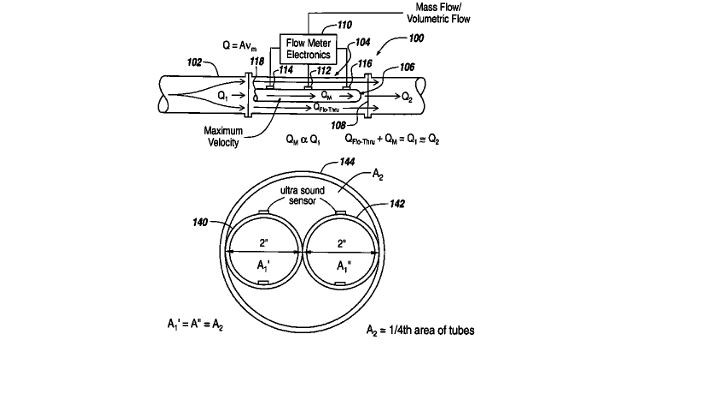
    Dualtube meter

    The assumption underlying most attempts to measure flow in large pipes is that it is necessary to build a measuring element at roughly the size of the pipe in order to accurately measure flow through a large pipe. For Coriolis meters, the vibrating flowtubes for a 12-inch meter are roughly 12 inches in diameter. The traditional approach of Coriolis meter designers to measuring flow in large pipes is to build a larger flowtube, increase tube diameter, increase driver power, manage vibration and structural issues, and measure all flow through one Coriolis meter.

    An alternative approach might be fruitful. What if instead of building larger sensing elements, we divide the flow into two or more smaller paths, measure the flow within those paths, and then combine those measurements to determine total flow through the large pipe? For example, instead of building a single 12-inch Coriolis meter, the flow could be divided into two 6-inch measurement tubes. Once the two flows are measured through those tubes, they are reunited and flow measurement through the large pipe can be determined. This makes the Coriolis measurement possible with smaller and more manageable vibrating tubes.

    The same principle can be applied to other flow technologies, including at least vortex, ultrasonic, turbine, thermal, differential pressure (DP), and magnetic. Rather than continuously building larger flow elements, divide the flow, measure it in smaller and better controlled passages, and then combine the results. Smaller Coriolis tubes are easier to vibrate, and smaller vortex meters generate higher shedding frequencies and stronger signals. Yet the result is the same: measurement of flow through a 12-inch pipe. Smaller measuring elements may also be less expensive to build and calibrate than a single large sensor.

    This concept is not purely theoretical. I was issued patents in 2015 and 2017 covering dualtube architecture based on this principle. Turbine and vortex prototypes were subsequently built by two manufacturers and then tested at CEESI in 2019 and 2020. Following the tests, the CEESI engineer responsible for the work stated: “We were able to prove out the basic principle of the meter. I also agree that this design can also be applied to larger geometry.” The testing at CEESI demonstrates that flow can be divided, measured through multiple internal measurement paths, and then recombined to determine flow in a larger pipe.

    But the story doesn’t end there. This concept has evolved into a broader hybrid measurement platform. Because the measurement is technology-independent, different flow technologies can be combined in the same system. One possibility is combining Coriolis and ultrasonic measurement paths. The entire structure also serves as a primary element, since there is pressure drop, yielding a third measurement of DP flow. Such a hybrid meter would have powerful diagnostic capabilities. Adding a densitometer enables direct mass flow calculation, while adding temperature and pressure measurement provides additional diagnostics and verification.

    Viewed this way, the dualtube architecture becomes more than a single meter design. It becomes a platform for combining multiple measurement technologies within a single flow measurement system. The underlying idea is simple: Rather than continuously building larger and larger measuring elements, it may sometimes be more effective to divide the flow, measure it in smaller and better-controlled passages, and then recombine the results. The original dualtube prototypes demonstrated the principle. The next step is to explore how that principle can be extended into a new generation of hybrid and multivariable flow measurement systems.

    Blog by Jesse Yoder, PhD

    For more information, please see our Dualtube Flowmeter page.

  • Filling in the Blanks in the Vortex Story

    I’ve learned a lot since I first set out to determine who introduced the first working commercial vortex flowmeter. I found out that it was Yokogawa in Japan, who introduced insertion vortex meters for flare stacks. The development of this meter was done in Japan, and was based on university and academic research. This was Yokogawa’s main vortex meter until 1979, when it came out with the YEWFLO.

    The other company involved in this story at the time was Eastech. Eastech was formed in 1968 by Dr. Douglas F. White, Alan E. Rodely, and Charles L. McMurtrie. Rodely was from Austria and was granted a German patent on vortex meters in 1968. However, this patent was not recognized in the United States. In 1969 Rodely filed a patent in the US for a bluff body flowmeter. This was granted in 1971. In 1973, Rodely received another patent a vortex meter for use in controlling air pollution in internal combustion engines. In 1974, Theodore Fussell received two patents involving the use of shuttle balls to detect vortices.

    I have heard the same story from several independent sources, and the patents bear it out. Eastech first began designing vortex flowmeters using shuttle balls to detect vortices coming off a bluff body. When this didn’t work well, the Eastech engineers turned to the use of thermistors to detect differences in temperature in the vortices. The problem with this approach was that the thermistors were not rugged enough to handle the swirls coming off the bluff body, so this approach was also not successful. It wasn’t until the Eastech engineers began using piezoelectric sensors that they were successful in building a viable vortex meter.

    Since Eastech did not receive patents for the use of shuttle balls in detecting vortices until 1974, it would appear that the above sequence of events occurred from 1973 to the late 1970s. In the meantime, Eastech was sold to Neptune International, which at that time was busy making oscillating piston (positive displacement) meters. While Eastech did succeed in making some commercial vortex meters during this time, no sales figures are available. It is safe to say the number of vortex meters that Eastech actually sold, if any, was quite small. All these events occurred long after Yokogawa introduced its first insertion vortex meter in Japan for flare stacks.

    In 1983, Neptune Eastech was sold to G. Corson Ellis Jr. Associates. This is the same person who was involved in forming Kessler Ellis Products (KEP). Ellis called his vortex products “Neptune Vortex.” It is highly likely that it was Corson Ellis and an associate, possibly Theodore Fussell, that sold Neptune Vortex to Frank Sinclair in 2000. Sinclair retired the product line in 2001.

    In the meantime, Frank Sinclair purchased the ultrasonic product line from Badger Meter. He called his new company Eastech Flow Controls. Frank Sinclair received a patent for the cartridge meter, an ultrasonic meter designed to measure flow in partially filled pipes, in 2010. This is a product that Eastech Flow Controls still sells today. Badger Meter, meanwhile, got back into the ultrasonic business when it purchased Racine Federated in 2012.

    Dynasonics was the ultrasonic division of Racine. In 2016, Badger also absorbed the vortex meters of Nice Instrumentation, a company founded by Gerry Nice in 1985. Gerry Nice had worked for Neptune Eastech in the mid 1970s and then Kessler Ellis Products before forming Nice Instrumentation in 1985.
    The accompanying graphic shows the timeline for the development of Eastech’s vortex meters. For more information, go to http://www.flowresearch.com/vortex.

    In the meantime, Frank Sinclair purchased the ultrasonic product line from Badger Meter. He called his new company Eastech Flow Controls. Frank Sinclair received a patent for the cartridge meter, an ultrasonic meter designed to measure flow in partially filled pipes, in 2010. This is a product that Eastech Flow Controls still sells today. Badger Meter, meanwhile, got back into the ultrasonic business when it purchased Racine Federated in 2012. Dynasonics was the ultrasonic division of Racine.

    In 2016, Badger also absorbed the vortex meters of Nice Instrumentation, a company founded by Gerry Nice in 1985. Gerry Nice had worked for Neptune Eastech in the mid 1970s and then Kessler Ellis Products before forming Nice Instrumentation in 1985.

    Blog by Jesse Yoder, PhD