
Flow measurement in large pipes has long presented a challenge for many types of flowmeters. Coriolis meters become heavier, more unwieldy, and more expensive as the line sizes they are measuring increase. Vortex meters face similar issues. As line sizes increase, bluff bodies grow larger and vortex shedding frequencies decrease. Ultrasonic meters actually do better as line sizes increase, but large acoustic path lengths may weaken the signal. Both clamp-on and insertion ultrasonic meters address the issue of line size but their performance does not typically rise to the level of inline meters.
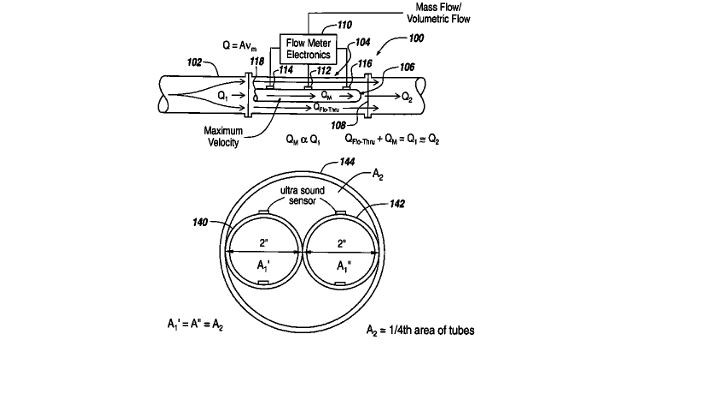
The assumption underlying most attempts to measure flow in large pipes is that it is necessary to build a measuring element at roughly the size of the pipe in order to accurately measure flow through a large pipe. For Coriolis meters, the vibrating flowtubes for a 12-inch meter are roughly 12 inches in diameter. The traditional approach of Coriolis meter designers to measuring flow in large pipes is to build a larger flowtube, increase tube diameter, increase driver power, manage vibration and structural issues, and measure all flow through one Coriolis meter.
An alternative approach might be fruitful. What if instead of building larger sensing elements, we divide the flow into two or more smaller paths, measure the flow within those paths, and then combine those measurements to determine total flow through the large pipe? For example, instead of building a single 12-inch Coriolis meter, the flow could be divided into two 6-inch measurement tubes. Once the two flows are measured through those tubes, they are reunited and flow measurement through the large pipe can be determined. This makes the Coriolis measurement possible with smaller and more manageable vibrating tubes.
The same principle can be applied to other flow technologies, including at least vortex, ultrasonic, turbine, thermal, differential pressure (DP), and magnetic. Rather than continuously building larger flow elements, divide the flow, measure it in smaller and better controlled passages, and then combine the results. Smaller Coriolis tubes are easier to vibrate, and smaller vortex meters generate higher shedding frequencies and stronger signals. Yet the result is the same: measurement of flow through a 12-inch pipe. Smaller measuring elements may also be less expensive to build and calibrate than a single large sensor.
This concept is not purely theoretical. I was issued patents in 2015 and 2017 covering dualtube architecture based on this principle. Turbine and vortex prototypes were subsequently built by two manufacturers and then tested at CEESI in 2019 and 2020. Following the tests, the CEESI engineer responsible for the work stated: “We were able to prove out the basic principle of the meter. I also agree that this design can also be applied to larger geometry.” The testing at CEESI demonstrates that flow can be divided, measured through multiple internal measurement paths, and then recombined to determine flow in a larger pipe.
But the story doesn’t end there. This concept has evolved into a broader hybrid measurement platform. Because the measurement is technology-independent, different flow technologies can be combined in the same system. One possibility is combining Coriolis and ultrasonic measurement paths. The entire structure also serves as a primary element, since there is pressure drop, yielding a third measurement of DP flow. Such a hybrid meter would have powerful diagnostic capabilities. Adding a densitometer enables direct mass flow calculation, while adding temperature and pressure measurement provides additional diagnostics and verification.
Viewed this way, the dualtube architecture becomes more than a single meter design. It becomes a platform for combining multiple measurement technologies within a single flow measurement system. The underlying idea is simple: Rather than continuously building larger and larger measuring elements, it may sometimes be more effective to divide the flow, measure it in smaller and better-controlled passages, and then recombine the results. The original dualtube prototypes demonstrated the principle. The next step is to explore how that principle can be extended into a new generation of hybrid and multivariable flow measurement systems.
Blog by Jesse Yoder, PhD
For more information, please see our Dualtube Flowmeter page.