
Temperature sensors
Photo by Jesse Yoder
The temperature sensors market is diverse. We have found that it is shifting from thermocouples to Resistance Temperature Detectors (RTDs), and a shift within RTDs from wirewound to thin-film. (See below for an excerpt by Dr. Jesse Yoder on “The Hot and Cold of Industrial Temperature Measurement” from The Tao of Measurement.
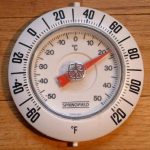
Common temperature sensors and accessories include thermocouples, resistance temperature detectors (RTDs), thermistors, infrared thermometers, fiber optic temperature sensors, and thermowells.
Temperature transmitters
Temperature transmitters take input from a temperature sensor and convert it into a form that is suitable for transmitting a signal over a long distance. Most temperature transmitters either convert the sensor signal to 4-20 mA or to some type of digital signal. In the process of doing this, the signal is conditioned and amplified so it can more easily be transmitted. This is necessary because the voltage or resistance signal of most temperature sensors is very small. It is difficult to transmit this signal accurately over a distance due to wire resistance and electromagnetic or radio frequency (RF) interference.
There are five main types or temperature transmitters:
Analog
Analog transmitters are very widely used when a 4-20 mA signal is desired. There is a very large installed base of analog temperature transmitters in process and other manufacturing plants. Because end-users often replace like with like when ordering a replacement product, analog transmitters still form a large portion of the temperature transmitter market.
Low-cost
The term low-cost is obviously a relative term, and what is low cost to one person might not be “low cost” to another. The term low cost also has a different meaning for temperature transmitters than it does for other field devices such as pressure transmitters. This is because the prices of temperature transmitters are consistently lower than the prices of pressure transmitters. This is primarily due to the more complex and sophisticated sensors required for pressure transmitters when compared to temperature transmitters. Also, the cost of the sensor is included in the price of a pressure transmitter, while for temperature transmitters sensor cost is a separate item. The prices of pressure transmitters range from under $200 to over $1,000, while temperature transmitters are available for under $100. A price of $250 might be considered “low cost” for a pressure transmitter, but $250 is close to an average price for an analog temperature transmitter.
The primary characteristic of analog temperature transmitters is having a 4-20 mA output. Just as there is a very large installed base of analog temperature transmitters in manufacturing plants, so there is a very large installed base of controllers and monitors that accept a 4-20 mA input. This is changing over time as new plants are built and as more companies buy more instrumentation. However, “smart” never had the same impact on the temperature market that it did in pressure or even flow, and many users are still buying analog temperature transmitters.
Programmable
Some analog temperature transmitters can be programmed used a handheld device or a personal computer. Values that are typically programmed into a temperature transmitter are sensor type (e.g., a thermocouple of a certain type or an RTD), span value, etc. While smart temperature transmitters are programmable by definition, there is a group of primarily analog transmitters that are called “programmable.” These have the same features as analog transmitters, except that they are programmable.
Smart
Honeywell introduced the first smart pressure transmitter in 1983. Since that time, “smart” devices have gained in popularity each year. Even so, it took nearly ten years for smart pressure transmitters to gain substantial market share. Users are often very slow to adapt to new technologies, and installed base has a major impact on decision making. As noted above, smart temperature transmitters have never had the same popularity as smart pressure transmitters.
The primary characteristic of a smart temperature transmitter is having a digital output. However, “smart” refers to more than one characteristic. To be smart, device must have the following three features:
- Microprocessor based
- Digital output
- Capable of remote two-way communication
The above are defining characteristics for any smart field device. The following are additional characteristics that smart transmitters typically have:
- Higher accuracy than analog transmitters
- Remotely programmable
- Capable of accepting more than one type of sensor
High-tier
In addition to smart temperature transmitters, leading suppliers have introduced enhanced, high-performance temperature transmitters called “high-tier” temperature transmitters. While these transmitters are smart devices, they are more advanced than most smart transmitters and are characterized by features that enhance performance rather than their ability to communicate with other devices:
- Higher accuracy than smart temperature transmitter
- Capability of accepting more than one type of sensor
Fieldbus
The efforts to create a universal fieldbus began in 1985, and they are continuing today. A fieldbus is a communication protocol that enables devices from different vendors to operate together. A fieldbus also makes it possible to send a number of signals from field devices to the control room over the same pair of wires. This drastically reduces wiring requirements because it is no longer necessary to dedicate one pair of wires to each field device. Finally, fieldbus makes it possible for field devices to talk to each other directly, instead of communicating only via the control room.
The two primary fieldbuses available today are Foundation Fieldbus and Profibus P.A. (process automation). While many or the world’s competing suppliers, including Rosemount, Honeywell, and Yokogawa, have rallied around the Fieldbus Foundation protocol, hopes for a universally accepted fieldbus have been dashed by continued support for Profibus P.A. Support for Profibus P.A. comes from Siemens and companies that develop Siemens products, and it is strongest in Europe. Profibus has not gained much of a foothold in North America. However, Siemens’ strength in Europe means that these protocols will continue to compete for the foreseeable future.
While the adoption rate has been slow, end-users are now showing an acceptance of Foundation Fieldbus and Profibus products. Companies that are developing fieldbus products are typically choosing to develop fieldbus pressure or flow products before they develop fieldbus temperature transmitters. Users who buy fieldbus products are currently doing so either for new plants or on a pilot basis. However, fieldbus will grow in temperature as more new plants are built and as more new products become available.
The Hot and Cold of Industrial Temperature Measurement
“The Hot and Cold of Industrial Temperature Measurement” from Jesse Yoder’s book, The Tao of Measurement.